Dienstag, 14. Juni 2022

Working group IANiS next meeting

Ph.D. students, PostDocs, and affiliated members of SFB-TR 87 are invited to contribute ideas and directions towards future joint plasma and materials science research projects. Inspired by the established insights of the past and current funding phases, we ask every subproject to bring up the most exciting and innovative scientific topic in a short pitch. Brainstorming together in the group will enable to generate new ideas and identify promising directions.

The workshop will proceed in two parts (this is part 2):

1) Participants review challenges presently encountered, as well as possible pathways envisioned to tackle them. (13-Jan-2022)

2) Discussion of the previously proposed topics and topics possibly discussed during the Summit Meeting, with a focus on overlap in research questions and a common agenda for potential future proposals. (22-Jun-2022)

We explicitly invite all project areas of SFB-TR 87 as well as the Mercator Fellows of SFB-TR 87 and intend to foster a continued  exchange towards future collaborations.

Freitag, 1. April 2022

Rahel Buschhaus from project C7 wins poster prize at DPG conference 2022

Congratulations to Rahel Buschhaus from experimental physics II who won the poster prize in the category 'Phd students in low-temperature plasma physics'. During the annual DPG spring meeting, Mrs. Buschhaus presented a poster entitled 'Ion-induced secondary electron emission of metal surfaces analyzed in an ion beam experiment'. This was rated as the best poster by the reviewers during the poster session. She received the best rating among 25 posters in its category.

Dienstag, 15. Februar 2022

IGK lecture Alexander Kirnbauer

In the frame of IGK within the SFB-TR 87, Univ.Ass. Dipl.-Ing. Dr.techn. Alexander Kirnbauer from TU Wien will hold a presentation on Thursday, March 17th, 2022, 16:00 h – 18:00 h, at Materials Chemistry in Aachen. The title of his talk will be Transition metal nitrides as protective coatings: From TiN to MEN to HESN. The meeting will be online. All interested people are invited to join!

Dienstag, 1. Februar 2022

IKG lecture by Dr. techn. Rainer Hahn

As part of the IGK in SFB-TR 87, Dr. techn. Rainer Hahn, TU Wien, will give a lecture at the Materials Chemistry in Aachen on Monday, March 14, 2022, 14:00 - 16:00. The title is "Fracture properties of CrN hard coatings: Influence of the microstructure, al-loying elements, and coating architecture".


Montag, 3. Januar 2022

Upcoming Seminar of the IGK of D.G. Sangiovanni

In the frame of IGK within the SFB-TR 87, D.G. Sangiovanni from Linköping University, Sweden will held a presentation on Wednesday, January 19th, 2022, 10:00 h – 12:00 h, at Materials Chemistry in Aachen. The title of the presentation is Competition between plasticity and brittleness in refractory ceramics, the meeting will be online.

All SFB-TR 87 members are invited to join the presentation.

Montag, 22. November 2021

Upcoming Seminar Sylvain Dubois

In the frame of IGK within the SFB-TR 87 will be an online seminar on Monday, December 13th, 2021, 14:00 h – 16:00 h, at Materials Chemistry in Aachen.

Pr. Sylvain Dubois, Université de Poitiers:

Part I:             Recent advances in MAX phase solid solutions,

Veronique Brunet-Gauthier, Université de Poitiers:

Part II:             High-temperature oxidation of alumino-forming MAX phases: relationship between powder metallurgy processing routes, microstructural characteristics and oxidation resistance.

Donnerstag, 11. November 2021

Upcoming Seminar Dr. Helmut Riedl on 16/12/2021

Dr. Helmut Riedl from TU Wien is going to talk on December 16, 2021 in the frame of IGK within the SFB-TR 87 on Thursday, December 16th, 2021, 10:00 h – 12:00 h, at Materials Chemistry in Aachen.


Part I: Durability of physical vapor deposited CrN based coatings – Insights on fracture and fatigue mechanisms 


Tailoring the intrinsic fracture characteristics of hard protective coatings towards the fatigue proper-ties of state-of-the-art bulk materials is paramount for extending the fatigue-life of coated compo-nents. Thus, an in-depth knowledge on the failure pathways of ceramic-based thin films – typically lacking in intrinsic ductility – but also coated components under cyclic loading is imperative to extend their lifetime. Within this seminar, I want to discuss novel approaches in the field of fatigue testing of thin films on the example of dc magnetron sputtered as well as cathodic arc evaporated CrN. 

In detail, to reveal the intrinsic fracture toughness (KIC) and critical failure aspects of thin films under various loading conditions quasi-static and cyclic bending of pre-notched, unstrained micro-cantilever beams in conjunction with in-situ synchrotron X-ray diffraction have been performed. Up to the high-cycle fatigue regime (i.e., N = 107 cycles), the failure of CrN coatings is shown to be dominated by the inherent fracture resistance instead of well-described fatigue phenomena, with further correlations drawn to apparent growth irregularities (i.e. macro particles or structural defects). The observed frac-ture behaviour is further associated with large-scale dynamic-mechanical analysis of coated Ti6Al4V platelets to consider stress fields induced by the coating-substrate interface. The results are expected to provide key-insights into the underlying mechanisms promoting crack growth in PVD coated speci-mens combining the world of micro- and macro scale testing methods. 


Part II: Ternary transition metal diborides: A new generation of protective coating materials? 


Future high-performance components used in aviation or energy production require customized protective coating materials to fulfil specific criteria on efficiency as well as durability. Next to well-established nitride-based coatings are boron containing systems an upcoming and highly promising coating class. Here, ternary transition metal diborides are relatively unexplored compared to their bi-nary counterparts such as hard and inelastic TiB2. Typically, these hard ceramic based coatings fail due to their extremely limited capability for plastic deformation as well as a pronounced formation of vol-atile (boron based) oxides. Within this seminar, I want to discuss these specific challenges for different binary and ternary model systems exhibiting outstanding material properties, i.e. long-term oxidation resistance at 1200 °C or a fracture toughness above 4.8 MPa·m1/2, while maintaining super hardness. To systematically describe various aspects in the design and syntheses of non-reactively sputter de-posited boride-based coating materials, a broad set of high-resolution techniques (i.e. HR-TEM, APT, ERDA, or micro-mechanical testing) but also atomistic modelling (DFT using VASP) is applied. 

Mittwoch, 10. November 2021

Dienstag, 9. November 2021

Upcoming Project Workshop – „Future Ideas and Directions“

Ph.D. students, PostDocs, and affiliated members of SFB-TR 87 are invited to contribute ideas and directions towards future joint plasma and materials science research projects. Inspired by the established insights of the past and current funding phases, we ask every subproject to bring up the most exciting and innovative scientific topic in a short pitch. Brainstorming together in the group will enable to generate new ideas and identify promising directions.


The workshop will proceed in two parts:

  1. Participants review challenges presently encountered, as well as possible pathways envisioned to tackle them. (13.01.2022)
  2. Discussion of the proposed topics with a focus on overlap in research questions and a common agenda for potential future proposals. (date to be defined)


We explicitly invite all project areas of SFB-TR 87 and intend to foster a continued exchange towards future collaborations.


Registration: Via email to all organizers listed below, deadline 13.12.2021


Preliminary Agenda


09.45 - 10.00: Welcome

10.00 - 12.00: Pitches (< 10 minutes) + discussion

12.00 - 13.00: Break

13.00 - 1x:00: (depending on the number of participants)

1x.00: End of workshop


Organizers


Marcus Hans, RWTH Aachen University, hans@mch.rwth-aachen.de

Jan Trieschmann, BTU Cottbus-Senftenberg, jan.trieschmann@b-tu.de

Montag, 8. November 2021

Upcoming Seminar Dr. Michael Tkadletz

Dr. Michael Tkadletz from the Department of Materials Science, Montanuniversität Leoben will held a presentation (via zoom) in the frame of IGK within the SFB-TR 87 on Wednesday, December 1st, 2021, 10:00 h – 12:00 h, at Materials Chemistry in Aachen.
 

Part I:
Nanolamellar chemical vapor deposited fcc-Ti1-xAlxN – History, peculiarities and future perspectives

With an Al metal ratio x of ~0.8 while still maintaining a single phase face-centered cubic (fcc) structure, chemically vapor deposited (CVD) Ti1-xAlxN represents an intriguing counterpart to physically vapor deposited (PVD) Ti1-xAlxN, which usually exhibits an fcc/wurtzitic dual phase structure already at Al metal ratios of ~0.6-0.7. Considering the metastable nature of fcc-Ti1-xAlxN and the high deposition temperatures of ~800-900 °C necessary in thermally activated CVD processes, which are commonly considered to result in conditions close to thermal equilibrium, this is even more exceptional. The formation of a predominantly fcc structure at such high Al metal ratios is related to the typically observed unique microstructure of CVD fcc-Ti1-xAlxN, consisting of comparatively large grains with alternating Ti-rich and Al-rich fcc-Ti1-xAlxN nanolamellae exhibiting a periodicity of ~10 nm. Within this talk, the historical evolution and the current state of research on CVD Ti1-xAlxN coatings will be outlined, with a special emphasis on the nanolamellar structure. Important aspects such as thermal stability, age hardening be-havior and oxidation resistance will be discussed on the basis of in situ and ex situ character-ization techniques and the results will be compared with PVD Ti1-xAlxN counterparts. Finally, the role of the deposition parameters, contradictions of recent studies and future perspectives will be illuminated.

Part II: 
Synchrotron radiation based X-ray diffraction techniques for the advanced microstruc-
tural characterization of transition metal nitride coatings  

Within this talk, different synchrotron radiation based X-ray diffraction (XRD) techniques which significantly contribute to the establishment of microstructure-property relationships of complex coating systems will be presented. Special emphasis will be laid on requirements, advantages and disadvantages of the different approaches including sample preparation, experimental ex-ecution, calibration as well as data treatment and evaluation. The presentation will cover high resolution 1D powder XRD for the investigation of phase composition and lattice parameters at room and elevated temperature. In situ 2D powder XRD studies performed in inert and am-bient atmosphere will be discussed to highlight the strength of modern evaluation techniques such as sequential and parametric Rietveld refinement. The potential of the unique instrumen-tal combination of in situ powder XRD with simultaneous differential scanning calorimetry to study the thermal and oxidation stability will be demonstrated, allowing to directly correlate phase changes with the recorded heat flow, while in situ experiments performed on compact coating samples reveal the macroscopic strain throughout such events. In addition, the utiliza-tion of laterally resolved diffraction techniques will be discussed on the example of cross-sec-tional X-ray nanodiffraction applied to graded coating samples. Concluding, synchrotron and lab-based XRD techniques and their pros and cons will be compared. 

Mittwoch, 29. September 2021

Upcoming Seminar from Dr. Grzegorz Greczynski

Liebe Kollegen und SFB-Mitglieder,
Dear colleagues and SFB members,

hiermit laden wir Sie alle herzlich zu folgendem Vortrag (per Zoom) im Rahmen des IGK des SFB-TR 87 am Donnerstag, dem 16.12.2021, 14:00 Uhr – 16:00 Uhr, bei Materials Chemistry, RWTH Aachen, ein.

Herewith we invite all of you to the presentation (via zoom) below in the frame of IGK within the SFB-TR 87 on Thursday, December 16th, 2021, 14:00 h – 16:00 h, at Materials Chemistry in Aachen.

Dr. Grzegorz Greczynski:

Part I: Toward energy-efficient physical vapor deposition: routes for replacing substrate heating during magnetron sputter deposition by employing metal ion irradiation.

Part II: X-ray photoelectron spectroscopy studies of high-temperature oxidation of magnetron-sputtered thin films.

View the full seminar description here.

Mittwoch, 15. September 2021

Upcoming Seminar "Insights into initial stages of oxidation processes of protective coatings from AIMD modelling", Dr. David Holec

Liebe Kollegen und SFB-Mitglieder,
Dear colleagues and SFB members,
 
hiermit laden wir Sie alle herzlich zu folgendem Vortrag (per Zoom) im Rahmen des IGK des SFB-TR 87 am Mittwoch, dem 06.10.2021, 11:00 Uhr – 13:00 Uhr, bei Materials Chemistry, RWTH Aachen, ein.
 
Herewith we invite all of you to the presentation (via zoom) below in the frame of IGK within the SFB-TR 87 on Wednesday, October 6th, 2021, 11:00 h – 13:00 h, at Materials Chemistry in Aachen.
 
    Dr. David Holec
 
"Insights into initial stages of oxidation processes of protective coatings from AIMD modelling"

View full seminar description here.

Upcoming Seminar from Stephanos Kostantinidis

Liebe Kollegen und SFB-Mitglieder,
Dear colleagues and SFB members,

hiermit laden wir Sie alle herzlich zu folgendem Vortrag (per Zoom) im Rahmen des IGK des SFB-TR 87 am 08.10..2021, 09:30 – 11:30 Uhr, bei Materials Chemistry, RWTH Aachen, ein.

Herewith we invite all of you to the presentation (via zoom) below in the frame of IGK within the SFB-TR 87 on October 8th, 2021, 09:30 - 11:30 h, at Materials Chemistry in Aachen.

Stephanos Konstantinidis, PhD 
Université de Mons
Laboratory for Plasma Surface Interactions (ChIPS)

Part I:

High-Power Impulse Magnetron Sputtering: plasma diagnostics, film growth, and new trends

Part II:

Sputtering onto liquids, from nanoparticles to polymer nanocomposites
Zoom links will be sent 1 day before the workshop.

View full seminar description here.

Freitag, 20. August 2021

Online-Workshop "Verhandeln" am 01. & 04.10.2021

Online-Workshop „Verhandeln“

„Verhandlungen sind essentielle Erfolgsfaktoren in verschiedensten Berufen, egal ob wir über unser Gehalt, Verträge oder Arbeitsbedingungen verhandeln oder ob wir versuchen, einen Konflikt zu lösen. Manche Leute fürchten sich vor Verhandlungen oder lehnen diese ab, weil sie nicht gerne 'feilschen', um zu 'gewinnen'. Keine Sorge. In diesem Kurs werden Sie Verhandlungs-Prinzipien kennenlernen, die gut für Ihre sozialen Beziehungen sein werden. Das ermöglicht es Ihnen, nachdrücklich aufzutreten, ohne Ellenbogen einzusetzen. Die Prinzipien sind auf eine Reihe an verschiedenen Situationen anwendbar.“


Diese und weitere inhaltliche Informationen unter:
https://naturalscience.careers/wp-content/uploads/2020/10/Verhandeln-2.pdf


Termine: Fr 01.10.2021, 09:00 bis ca. 11:30 Uhr
Mo 04.10.2021, 09:00 bis ca. 11:30 Uhr
Ort: Online – detaillierte Informationen nach Anmeldung
Referent: Dr. Philipp Gramlich, NaturalScience.Careers
Zielgruppe: Doktorand*innen/Postdoktorand*innen, Wissenschaftler*innen des TR 87 und CRC 1316
Umfang: Zwei live Webinare (2-2.5 h) & individuelle Arbeitsphasen, Arbeitsmaterialien, optionales Extra – individuelles Feedback
 

Anmeldung & Kontakt: Vera Bracht (E-Mail: bracht@aept.rub.de)
Anmeldeschluss: 03.09.2021

Montag, 16. August 2021

Plasmas for all


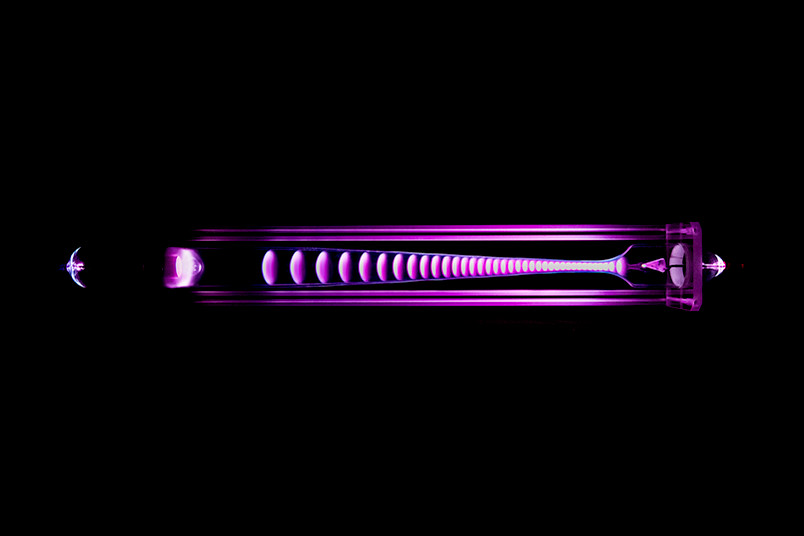
An experiment from the plasma van: A plasma is ignited between two electrodes. Plasma layers are created at regular intervals by accelerated electrons. © Damian Gorczany

A great many everyday technologies would not exist without plasmas. The teams of the Collaborative Research Centres want to share knowledge about their relevance with the public.

Driving the plasma van to school

For many years, the plasma researchers at RUB have been committed to introducing plasmas to school students in different year groups. “Physics teachers sometimes conduct experiments that involve plasmas, but the word plasma doesn’t even appear in the curriculum,” explains Science Manager Dr. Marina Prenzel. In order to familiarise secondary school students with the concept of a plasma, the SFB team, in cooperation with Professor Heiko Krabbe and other physics didactics experts, has constructed various plasma experiments that can be stowed away in boxes and handily transported in a minibus. The researchers use them for interesting 90-minute workshops in sixth-form classes, where students can do their own experiments and learn about different applications of plasmas. “This is how we want to create awareness that plasmas are extremely important for many of our current technologies,” says Prenzel.

Students evaluate research projects

Students should not only be given the chance to learn what a plasma actually is and where it is used. Rather, the SFB team is also currently setting up a project in collaboration with the physics didactics department that aims at promoting the evaluation skills of adolescents and young adults. Here, students are to gain insights into various plasma research projects and evaluate which of these projects they would support. Another goal is to convey the significance of plasmas for the challenges of global warming.

More than 20 years of plasma summer school

For more than 20 years, plasma researchers at RUB have been organising an annual international summer school for Master’s students and doctoral candidates. It originally emerged from a European Erasmus project, acquired under the auspices of the Eind­hoven University of Technology. When the funding ran out in 2000, the RUB team dedicated itself to continuing it. “The school is practically always overbooked,” says co-organiser Dr. Marc Böke. The 80 to 90 participants each year and the lecturers come from all over the world. The aim of the seven-day school is to give them insights into all the major technically relevant plasmas and, at the same time, to enable them to network with each other and with established researchers in the field. “Some of the former participants are now themselves running plasma labs,” says Böke. The RUB team hopes to resume the successful format soon, despite the coronavirus situation.

Virtual tours through plasma labs

Even though direct contact with the public is very limited during the coronavirus pandemic, the SFB team came up with a solution: The researchers made 360-degree recordings of their laboratories. This means that not only school classes, but also interested members of the public have the opportunity to take part in guided tours of the laboratories.

On 27 October 2021, the SFB 1316 team offers a virtual public tour free of charge. Registration is possible via email (sfb1316@rub.de). Participants will be send a link to the virtual tour.

~Author: Julia Weiler

Promotionspreis für Lukas Mai

Die Gesellschaft der Chemiker prämiert seine Dissertation, die Chemie, Material- und Ingenieurwissenschaften berührt.

Lukas Mai gehört zur Arbeitsgruppe Chemie Anorganischer Materialien; © RUB, Marquard


Dr. Lukas Mai von der Fakultät für Chemie und Biochemie erhält einen Preis der Gesellschaft der Chemiker (GDCh). Dabei handelt es sich um den H.C.-Starck-Tungsten-Promotionspreis 2021 der GDCh-Fachgruppe Festkörperchemie & Materialforschung. Prämiert wird Mais Dissertation „Investigation of Amino-Alkyl Coordinated Complexes as New Precursor Class for Atomic Layer Deposition of Aluminum, Tin and Zinc Oxide Thin Films and Their Application“. Die Urkunde und das Preisgeld von 2.500 Euro werden Ende August beim Wissenschaftsforum Chemie verliehen.
 

Interdisziplinäres Umfeld

Die ausgezeichnete Arbeit ist in einem interdisziplinären Umfeld zwischen Chemie, Material- und Ingenieurwissenschaften in der AG Chemie Anorganischer Materialien entstanden. Dabei wurden neue Chemikalien, sogenannte Präkursoren, untersucht, die für die Abscheidung von ultradünnen Schichten mittels Atomlagenabscheidung eingesetzt wurden. Diese nanostrukturierten Dünnschichten konnten dann in aktuellen Anwendungsbereichen als Gassensoren, Gasbarriere-Schichten oder in Transistoren getestet werden. Die beiden Projekte SFB-TR 87 und EFRE-FunALD, innerhalb welcher die Arbeit angefertigt wurde, haben für diese anwendungsorientierte Forschung die ideale Plattform dargestellt.
 
Die Atomlagenabscheidung oder Atomic Layer Deposition wird in der Mikroelektronik unter anderem für Computerchips, Displays und Sensoren eingesetzt, um verschiedene Materialien mit der Dicke von wenigen Nanometern (ein Millionstel eines Millimeters) auf Oberflächen aufzubringen. Dafür werden chemische Verbindungen, sogenannte Präkursoren, genutzt, welche volatil, thermisch stabil und reaktiv sein müssen. In der Industrie werden häufig Alkylverbindungen eingesetzt, die diese Bedingungen zwar erfüllen, aber sich an der Luft selbst entzünden und somit hoher Sicherheitsvorkehrungen bedürfen. Lukas Mai verwendete einen sogenannten 3-(Dimethylamino)propyl (DMP) Liganden, um Aluminium-, Zinn- und Zinkverbindungen zu stabilisieren, die dadurch sicherer sind und weiterhin alle Präkursorbedingungen erfüllen.
 
~Author: Arne Dessaul

Mittwoch, 18. November 2020

Samstag, 11. Juli 2020

2020 Bill Sproul Award and Honorary Lecture Recipient Jochen M. Schneider

Jochen M. Schneider, Ph.D., is Chair and Professor of Materials Chemistry at RWTH Aachen University, Germany.

Purpose

The Bill Sproul Award and Honorary ICMCTF lectureship is to recognize the achievements of a mid-career researcher who has made outstanding scientific and/or technological contributions in areas of interest to the Advanced Surface Engineering Division (ASED) of the AVS, with emphasis in the fields of surface engineering, thin films, and related topics.

Find the original Link here.


Lukas Mai and colleagues on new chemistry for ultra-thin gas sensors

© RUB, Marquard
A Bochum team has developed a new process for zinc oxide coatings that can be used in nitrogen oxide sensors and as protective coatings on plastics. The application of zinc oxide coatings in industry is manifold and ranges from the protection of perishable goods from air to the detection of toxic nitrogen oxides. Such layers can be produced by means of atomic layer deposition (ALD), which normally uses precursor chemicals, so-called precursors, which ignite immediately in air. An interdisciplinary research team at the Ruhr-Universität Bochum (RUB) has now established a new production process based on non-self-igniting precursors that takes place at such low temperatures that plastics can also be coated. The team reported in the magazine "Small", which selected the article for its title in the issue of 4 June 2020

Applying ultra-thin coatings.

To produce a sensor for nitrogen dioxide (NO2), a thin layer of nanostructured zinc oxide (ZnO) must be applied to a sensor substrate and then integrated into an electrical component. Prof. Dr. Anjana Devi's team used ALD to apply ultra-thin ZnO layers to such sensor substrates.

In general, ALD processes are used in industry to miniaturize electrical components by means of ultra-thin layers, some of which are only a few atomic layers thick, while at the same time increasing the efficiency. This requires precursors that react on a surface in the ALD process to form a thin layer. "The chemistry behind ALD processes is therefore essential and has a great influence on the resulting layers," emphasizes Anjana Devi.

Safe handling and highest quality 

In industry, ZnO coatings have so far been produced with an extremely reactive zinc precursor that ignites immediately in air, experts call it pyrophoric. "The key to developing a safe ALD process was to research a new, non-pyrophoric precursor that can be handled safely and is capable of producing ZnO coatings of the highest quality," said Lukas Mai, lead author of the study. "The challenge was to find an alternative chemistry capable of replacing pyrophoric, industrially used compounds".

The special feature of the new process is that it is even possible at low temperatures, which makes it possible to coat plastics. Thus, the new process is not only suitable for the production of gas sensors, but also for gas barrier layers. These are applied to plastic in industry and are used to protect sensitive goods such as food and medicines from air.

This was made possible by the interdisciplinary cooperation of natural scientists and engineers. The team included the working groups Chemistry of Inorganic Materials headed by Anjana Devi and General Electrical Engineering and Plasma Technology headed by Prof. Dr. Peter Awakowicz, researchers from Heinrich Heine University Düsseldorf and the company Paragon.
The work was funded by the European Fund for Regional Development (EFRE) in the Funald project and by the German Research Foundation in the framework of the Collaborative Research Centre/Transregional TR87. Lukas Mai was supported by the Stiftung der Deutschen Wirtschaft.

~Author Maike Drießen

Montag, 29. Juni 2020

Dr.-Ing. Schmidt is awarded for his outstanding dissertation

© RUB, Marquard
Technical plasmas are among the things that have a significant influence on the world around us, without many people knowing about it. "You can, for example, process surfaces with plasmas; but they are crucial in the production of modern computer chips, which are built into almost all modern technical devices - from cars to smart phones," explains Frederik Schmidt. "A better understanding of this technology leads to innovations that make our lives easier, network people and shape our future.

In his dissertation, he investigated how the energy gets into a plasma. The path from the power socket to nanometer-sized semiconductor tracks is being investigated by various specialists and is in part well understood. Frederik Schmidt has brought together two of these specialist areas: the electrical network between the power socket and the plasma on the one hand, and detailed plasma simulations on the other. This makes it possible to investigate the relationship between the two. "For example, I have looked at the paths along which energy flows and how much is lost on its way into the plasma. That is sometimes quite a lot," says the researcher. The results help to make systems and superstructures more efficient and thus more economical and ecological. In addition, he has developed his own electrical network that can be implemented for certain applications with considerably less effort and losses than before. "I was able to show theoretically that this works. Colleagues in France were then able to prove in experiments that it is also practically possible to build something like this," says Schmidt


~Author: Meike Drießen